
What is childhood myopia and why is it dangerous?
Myopia (nearsightedness) is not just an inconvenience. It is a progressive condition in which the eye grows faster than normal, creating lifelong vision risks.
How myopia develops
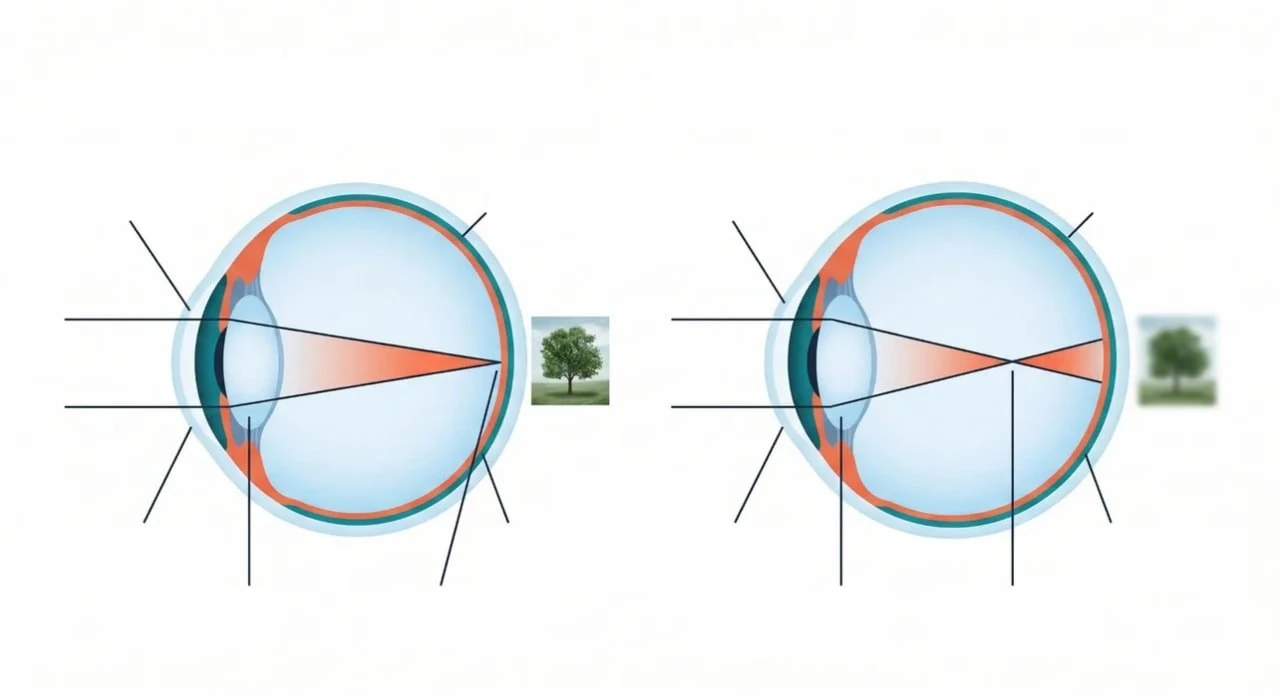
In normal vision, light focuses exactly on the retina. In myopia, the eyeball becomes too long, and the focus shifts in front of the retina. As a result, distant objects appear blurry.
In children, the eye continues to grow until 18-20 years of age. If this growth occurs too quickly, myopia progresses — each additional millimeter in eye length adds approximately 3 diopters.
Without control, myopia can progress at a rate of -0.5 to -1.0 D per year, turning a mild degree into a severe one in just a few years.
 Normal vision
Myopia (nearsightedness)
Cornea
Retina
Cornea
Retina
Lens
Focus
Cornea
Retina
Cornea
Retina
Lens
Focus
Normal vision
Myopia (nearsightedness)
Cornea
Retina
Cornea
Retina
Lens
Focus
Cornea
Retina
Cornea
Retina
Lens
Focus
Normal eye (left) vs myopic eye (right)
Degrees of myopia
The higher the degree, the greater the risks to eye health
Mild
up to -3.0 D
Initial stage. Minimal risks with proper control.
Moderate
-3.0 to -6.0 D
Increased risks. Requires regular monitoring and control.
High
over -6.0 D
Serious risk of complications: retinal detachment, glaucoma, cataracts.
Two paths of myopia development
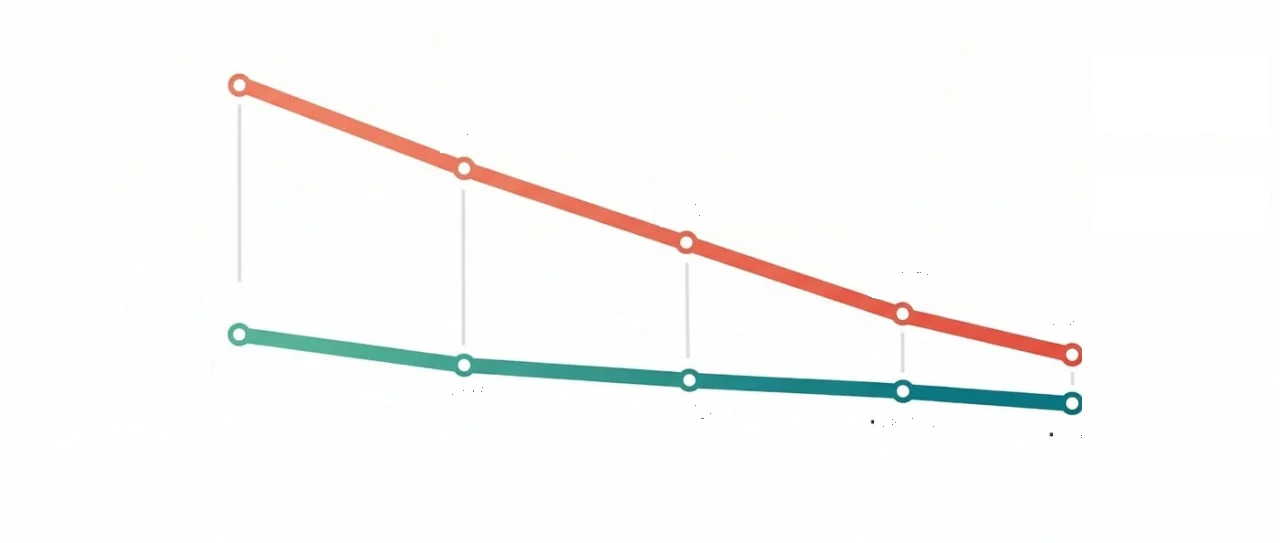
Early intervention radically changes the prognosis. Compare two scenarios: without control and with control.
 TOP PATH
Without control
BOTTOM PATH
With control
–1D
–4D
–7D
–10D
–12D
–1D
–2D
–3D
–3.5D
–4D
TOP PATH
Without control
BOTTOM PATH
With control
–1D
–4D
–7D
–10D
–12D
–1D
–2D
–3D
–3.5D
–4D
Without control
-1 D at age 7 → -12 D at age 18. High risk of lifelong complications.
With control
-1 D at age 7 → -4 D at age 18. Significantly lower risk of serious complications.
Complications of high myopia
A high degree of myopia (over -6 D) significantly increases the risk of serious eye diseases
Retinal detachment
Risk increases 5-fold. Can lead to irreversible vision loss.
Glaucoma
Increased intraocular pressure damages the optic nerve.
Cataracts
Lens clouding develops earlier and more rapidly in high myopia.
Maculopathy
Damage to the central retinal area — the leading cause of irreversible blindness in young people.
Source: Flitcroft DI. The complex interactions of retinal, optical and environmental factors in myopia aetiology. Prog Retin Eye Res. 2012
Frequently asked questions about childhood myopia
Short answers for parents. Details are in the sections above and in the blog.
What is myopia and why does it develop in children?
Myopia, or short-sightedness, is a condition in which the eyeball grows faster than normal and the focus shifts in front of the retina, so distant objects look blurred. A child’s eye keeps growing until 18–20, which is why myopia appears and progresses in childhood. It is encouraged by heredity, prolonged close work, screens and too little daylight outdoors.
How fast does myopia progress without control?
Without control a child’s myopia can grow by −0.5 to −1.0 D per year: every extra millimetre of eye length adds about 3 dioptres. So −1 D at age 7 becomes roughly −12 D by 18. With control the same child reaches 18 at −3 to −4 D with a much lower risk of complications.
What are the degrees of myopia?
Low: up to −3.0 D, an early stage with minimal risks if properly controlled. Moderate: from −3.0 to −6.0 D, increased risks, regular monitoring needed. High: above −6.0 D, serious risks of complications such as retinal detachment, glaucoma, cataract and maculopathy.
Why is high myopia dangerous?
Above −6 D the risk of retinal detachment is 5 times higher, glaucoma and cataract 3 times, maculopathy 9 times. Maculopathy damages the central zone of the retina and remains the leading cause of irreversible blindness in young people. Source: Flitcroft DI, Prog Retin Eye Res, 2012.
How can I tell that my child is becoming short-sighted?
The child squints at distant objects, sits closer to the screen or the board, bends low over books, complains of tired eyes and headaches after lessons, rubs the eyes. Childhood myopia often develops unnoticed, so with any of these signs, or if the parents are short-sighted, an eye check is worthwhile; meanwhile take the short risk test on this site.
Can myopia be cured?
No: myopia cannot be cured, the elongation of the eye is not reversible. But its progression can be slowed by 40–67 % with modern control methods: defocus spectacle lenses, orthokeratology, soft contact lenses and low-concentration atropine. The method is chosen by an ophthalmologist after an examination.
Don't delay the vision check-up
Early detection of myopia is the key to effective control. The sooner you start, the better the prognosis.